For teachers
Everything you need to walk your class through 130 years of everyday invention: a 15-minute prep, a projectable slideshow, printable handouts, and a plan for the visit itself. Aimed at grades 3–8, with notes to scale up or down.
Teachers — you’re in the right place
This hub is yours: prep below, project the slideshow, print the handouts. Students don’t need to read this page.
Students — explore the objects →
Send students to the student explorer: every object from the lesson, big pictures, full stories — all inside the classroom.
How to use this guide
Step 1
Prep in 15 minutes
Watch the walkthrough, skim the period stories below.
Step 2
Show the slideshow
A projectable lesson deck — stories, real photos, questions.
Step 3
Print the handouts
Pre-visit reading, scavenger hunt, post-visit worksheet, chaperone guide.
Step 4
Visit
Free admission in Pioneer Square; reserve a tour if you like.
Step 5
Follow up
The museum-label worksheet closes the loop back in class.
Beautiful Things is a free summer exhibition at the Occidental Fine Arts Center (311½ Occidental Ave S, Pioneer Square, Seattle): real antiques from roughly the 1850s to the 1980s — phonographs, a wall of vintage radios, film projectors, early televisions, the first home computers — alongside around 40 paintings and real archival photographs of early Seattle, carefully brought back to color.
The fastest prep is Andrew’s ten-minute walkthrough (right), then a skim of the period stories below — they’re the same content the slideshow and handouts use, so once you’ve read them, you’re ready to teach.
A note on the videos: the exhibition includes short, playful AI-made clips where antiques “talk.” The handful embedded in this guide were chosen for classroom use (household objects; no saloon-humor clips), but as always, preview before showing. The real/AI distinction is itself a great lesson — see the discussion prompts below.
Ten minutes through the whole show, with the curator.
Optional warm-ups (no materials)
15 min
Object detective
Hold up any classroom object. If this ended up in a museum in 2126, what would it tell people about us? This is exactly the thinking students will do in the gallery.
Homework
Interview a grown-up
Each student asks someone older: what's the oldest machine you ever used? Many of the machines they'll hear about are physically in the exhibition.
20 min
How did it reach you?
Pick a song or show students love. Trace how it would have reached a kid in 1950, 1930, 1900, and 1870. Draw the chain on the board.
Period 1 · 1850s–1890s · teach in ~10 min
Before electricity reached most homes, almost everything took muscle. Wool was spun into thread on a wheel you worked with your foot. Clothes were scrubbed on a washboard, butter was churned by hand, and a sewing machine ran off a hand crank or a foot pedal called a treadle. Washday was the hardest job of the week, and the hand-crank washing machine in the exhibition shows why: a wooden barrel for a tub, a heavy iron flywheel you turned yourself to stir the clothes, and a pair of wooden rollers on top called a wringer that squeezed the water back out. These objects were built to last decades, and you can still see the wear from the hands that used them.
Hear the era
The oldest recorded human voice
April 9, 1860 · 11 sec
Someone singing the French song 'Au clair de la lune,' scratched onto sooty paper by a phonautograph — a machine that could record sound but never play it back. Scientists finally turned the squiggles into sound in 2008.
First Sounds project restoration · Public domain (Wikimedia Commons) · source
Seattle in the same years— click a photo for the story
Talk about it
Look for this when you visit
Find the spinning wheel, the washing machine, and the butter churns. Look closely for worn spots — the shiny, smooth places show exactly where hands touched them for years.
See it in action: Wooden spinning wheel. Watch the wheel turn and the thread take shape. One of the exhibition’s “Antiques That Talk” films. The object is real, the photo behind it is real, the movement and voice are AI-made — ask the class which parts count as historical evidence.
Three real photographs of the fire and the rebuilt street — and every one of them was black and white when it was taken. The colour is a computer's best guess. Press the toggle and check it against the original.
More talking antiques
optional fun, ~30 seconds each · preview before class if you like
Period 2 · 1900s–1920s · teach in ~10 min
Imagine the first time anyone in your family heard music without a musician in the room. The phonograph made that possible: a needle rides the groove of a spinning disc, and a horn makes the vibration loud enough to fill a parlor — no electricity, no speaker, just clever shapes. The Victor III in the exhibition wears its horn out in the open. A few years later the horn was folded down inside a wooden cabinet, and the phonograph became a piece of standing furniture you kept in the living room. The Ediphone did the opposite job: it recorded your own voice onto a wax cylinder so a secretary could type it up later.
Hear the era
Thomas Edison speaks, 'Around the World on the Phonograph'
October 1888 · ~3 min (play the first minute)
Edison himself, on a wax cylinder — believed to be among the oldest surviving recordings of his voice. This is what the phonographs in the exhibition actually sounded like: real voices, real crackle.
Edison cylinder recording · Public domain (Wikimedia Commons) · source
'The Lost Chord' on an Edison cylinder
circa 1888 · ~2 min
Music recorded on an Edison 'Perfected' Phonograph cylinder — among the earliest surviving recorded music. Ask students: what do you hear besides the music?
Recorded by George Gouraud · Public domain (Wikimedia Commons) · source
Seattle in the same years— click a photo for the story
The same years, beyond Seattle
Edith Irvine with her cylinder phonograph, 1905
Mokelumne Hill, California: photographer Edith Irvine listens to a cylinder phonograph on her own porch — recorded music arriving in an ordinary home.
Shown with AI-added color. Open it to compare against the original black-and-white photograph.
Photo: Edith Irvine, 1905 · Public domain (Wikimedia Commons) · source
Talk about it
Look for this when you visit
Count the phonograph horns hanging in the gallery. Which shape do you think made the loudest sound, and why?
See it in action: Victor III disc-horn phonograph. The crank, the needle, and the first note out of the horn. One of the exhibition’s “Antiques That Talk” films. The object is real, the photo behind it is real, the movement and voice are AI-made — ask the class which parts count as historical evidence.
The Edison cylinder in 'Hear the era' is a real 1888 recording — crackle and all. The film of the Victor III is not: a computer invented that motion and that voice this year. One is evidence. One is a story about evidence.
Period 3 · 1880s–1960s · teach in ~10 min
The phonograph carried a voice across time. The telephone carried it across town. Seattle's first exchange opened on March 7, 1883 with ninety subscribers, and one operator — Harriet Hanson, who had memorized every single number, because printed directories did not exist yet. For the next eighty years the telephone changed shape almost every decade: a wooden box screwed to the kitchen wall that you cranked to reach the operator, a candlestick you held in two hands, a heavy black desk set, a payphone on a downtown wall, and finally the bright plastic rotary phones your grandparents grew up with. Not one of them had a screen, a battery, or a way to know who was calling.
Seattle in the same years— click a photo for the story
The same years, beyond Seattle
A row of switchboard operators, stations 20 to 25, April 7, 1927
Every call you made went through a person. Six operators at the Chesapeake and Potomac Telephone Company, plugging cords into a wall of holes to connect one voice to another.
Shown with AI-added color. Open it to compare against the original black-and-white photograph.
U.S. National Archives (NARA 522875) · Public domain (Wikimedia Commons) · source
Talk about it
Look for this when you visit
Find a telephone with no buttons and no screen. Work out how you would call a friend on it — and who else would have to help you.
See it in action: Kellogg wall-mount telephone. A 1910 grocery, and a call placed through the operator. One of the exhibition’s “Antiques That Talk” films. The object is real, the photo behind it is real, the movement and voice are AI-made — ask the class which parts count as historical evidence.
Harriet Hanson's portrait is a real 1883 cabinet card, and the colour on her dress is a guess made by a computer in 2026. Nobody alive knows what colour that dress was. That is exactly the kind of thing a colorized photo can never tell you.
Period 4 · 1920s–1940s · teach in ~10 min
Radio was the first time news, music, and stories arrived in the home instantly, for free, from far away. Families arranged their living rooms around the radio the way we arrange ours around screens. The exhibition has a whole wall of them: big wooden 'cathedral' radios shaped like church windows, a console radio the size of a dresser, a globe-shaped radio designed by one of the most famous designers in America, and later, small portable ones made of an early plastic called Bakelite — including a bright red one, when radios became something you could carry to the beach.
Hear the era
President Roosevelt's first 'fireside chat' (excerpt)
March 12, 1933 · 90 sec excerpt
The opening of the first fireside chat, on the banking crisis — a president speaking directly into millions of living rooms at once through radios like the ones on the exhibition's radio wall.
Miller Center of Public Affairs · Public domain (Wikimedia Commons), 92-second excerpt · source
Seattle in the same years— click a photo for the story
The same years, beyond Seattle
Woman and child listening to the radio, 1940
A farm home, June 1940: the radio as the center of the room. Government photographer Russell Lee documented daily life across America for the Farm Security Administration.
Shown with AI-added color. Open it to compare against the original black-and-white photograph.
Photo: Russell Lee, FSA, Library of Congress · Public domain (Wikimedia Commons) · source
Talk about it
Look for this when you visit
At the radio wall, find the biggest radio and the smallest one. Guess which decade each one comes from, then check the label.
See it in action: Raymond Loewy 'New World' globe radio. The globe radio has opinions about the twenty-first century. One of the exhibition’s “Antiques That Talk” films. The object is real, the photo behind it is real, the movement and voice are AI-made — ask the class which parts count as historical evidence.
This is the photograph to stop on. Russell Lee's 1940 picture of a mother and child at the radio is real, and the version with colour in it was made by a computer in 2026. Show both. Ask which one you would put in a history book, and why.
More talking antiques
optional fun, ~30 seconds each · preview before class if you like
Period 5 · 1890s–1950s · teach in ~10 min
Long before film, a magic lantern threw painted glass slides onto a bedsheet by lamplight — the first machine that let a whole room look at the same picture together. Film took the idea and added motion: a projector pulls a strip of pictures past a bright lamp fast enough to trick your eyes. The little Kodak Brownie box camera mattered just as much — it was cheap enough that ordinary families could finally take their own photographs, which is why we have pictures of everyday life from this era at all. Before television, this is also where people saw the news: short newsreels played before every movie.
Seattle in the same years— click a photo for the story
Talk about it
Look for this when you visit
Find the film projector and follow the film's path with your eyes: where does the reel feed in, and where does the light shine through?
See it in action: Vintage 5×7 and 8×10 photographs. A homestead kitchen in the 1890s, and the family album open on the table. One of the exhibition’s “Antiques That Talk” films. The object is real, the photo behind it is real, the movement and voice are AI-made — ask the class which parts count as historical evidence.
The Boeing photograph moves when you press play, and it never moved. A real still picture plus invented motion is the oldest trick in this deck — and the easiest one to miss.
Period 6 · 1940s–1950s · teach in ~10 min
Television combined everything that came before it: recorded sound, radio broadcasting, and moving pictures, all in one glowing box in the living room. The first sets were small, round-cornered screens set into wooden cabinets, built to look like furniture just as the radios had been; a few were moulded from Bakelite instead. The exhibition's rooftop antennas tell their own story — every family needed one to pull the picture out of the air, and city rooftops sprouted metal branches almost overnight.
The archival photo library covers roughly 1850–1950, so this period has no Seattle photographs — worth asking the class why the “historic photo” era seems to stop there.
The same years, beyond Seattle
Family watching television, 1958
One screen, one family, one show at a time — the living room rearranged around the glowing box, exactly as it had been around the radio twenty years earlier.
Shown with AI-added color. Open it to compare against the original black-and-white photograph.
Photo: Evert F. Baumgardner, National Archives · Public domain (Wikimedia Commons) · source
Talk about it
Look for this when you visit
Find the television antennas. They used to live on rooftops — what do you see on rooftops today instead?
See it in action: Early television in a wooden cabinet. The set warms up and the picture arrives. One of the exhibition’s “Antiques That Talk” films. The object is real, the photo behind it is real, the movement and voice are AI-made — ask the class which parts count as historical evidence.
Two AI films in this chapter, both of objects that are really in the room downstairs. The object is the evidence. The joke is not.
Period 7 · 1910s–1980s · teach in ~10 min
Computers did not appear from nowhere. For decades, offices ran on machines that could do exactly one thing: add. You pulled a lever on a Burroughs adding machine and gears carried the ones for you. Then came the Atari 2600, which brought video games into living rooms, and the Commodore VIC-20, one of the first computers cheap enough for a family to own — it plugged into the TV and had less memory than a single photo on a phone today. These objects are the start of the world you live in now, sitting just a few steps from a spinning wheel.
The archival photo library covers roughly 1850–1950, so this period has no Seattle photographs — worth asking the class why the “historic photo” era seems to stop there.
The same years, beyond Seattle
Programmers at the ENIAC, one of the first electronic computers, 1946
Forty years before the VIC-20 fit on a desk, a computer filled this entire room. Betty Snyder is on the right, holding the program; Glen Beck is at the far bank. You programmed it by walking around inside it and moving cables by hand.
Shown with AI-added color. Open it to compare against the original black-and-white photograph.
U.S. Army photo, Ballistic Research Laboratory · Public domain (Wikimedia Commons) · source
Talk about it
Look for this when you visit
Find the adding machine and the Commodore. Ask an adult in your group whether they ever used either one — and what it was for.
See it in action: Burroughs adding machine. The adding machine takes on a column of figures. One of the exhibition’s “Antiques That Talk” films. The object is real, the photo behind it is real, the movement and voice are AI-made — ask the class which parts count as historical evidence.
The machine in this photograph is the ancestor of the one that colorized the photograph. Everything you have been asked to question today was made by a descendant of ENIAC.
Bonus lesson · media literacy · ~20 min
This exhibition does something unusual and honest: it puts real artifacts and real archival photographs right next to clearly labeled AI-made films of them talking and moving. That makes it one of the best places anywhere to teach the difference between a primary source (the object or photo itself — evidence) and an interpretation (a story someone made about it). Every film in this guide starts from something real: the phonograph exists, the 1890 street photo was really taken. The voice, the motion, and the joke were invented by a computer this year.
One important honesty rule to share with students: some people in the archival photographs were real, identifiable people with names and descendants. The AI films in this exhibition animate objects and staged period characters — not named real people — and they are labeled as AI. Ask the class why that distinction matters.
We do it too — and here is the receipt
Every archival photograph in this program is shown with color that a computer added, because color holds a classroom’s attention far better than grey. We could have said nothing. What we do instead: each one wears an AI color chip, and each one carries the untouched black-and-white original one press away, on every screen and in the slideshow. Use the pair below as the worked example — it is the same photograph twice.
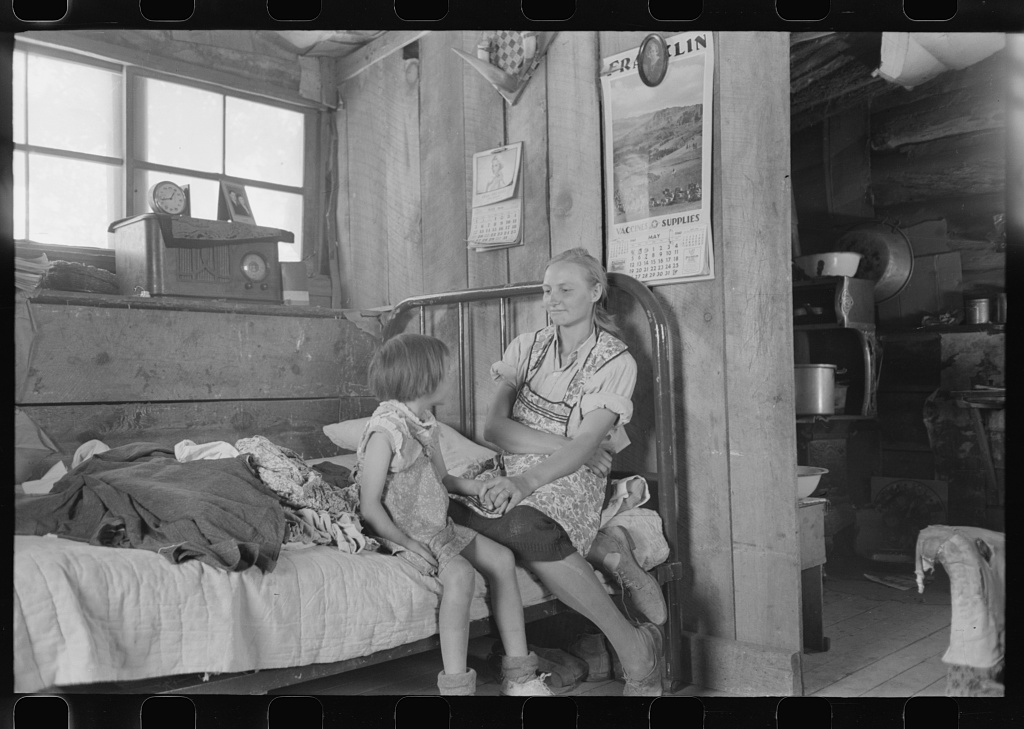 Real photograph
What is real
Every shape, every face, every fold of cloth, and every shadow. This is a real room in a real farmhouse in June 1940, and the photographer was standing in it.
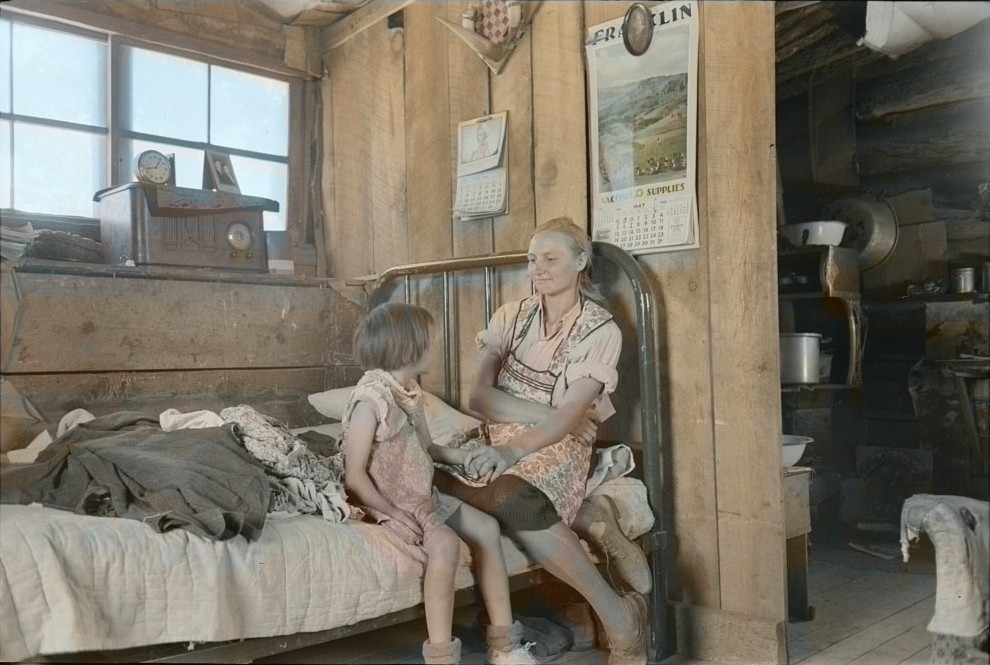 AI color
What the computer added
All of the colour. Nobody recorded what colour that dress was, or the quilt, or the walls. A model guessed from thousands of other photographs — a good guess, and still a guess.
Woman and child listening to the radio, 1940 · Photo: Russell Lee, FSA, Library of Congress · Public domain (Wikimedia Commons)
Detective clues: how to spot the invention
Talk about it
The compare activity (15 min + printable)
Show a Seattle photo from any period above, then its film (“Watch this photo come to life” in the photo pop-up). Students sort what they saw into three columns: I can verify (it’s in the original photo), the AI inferred (invented, even if plausible), and I still wonder (questions a historian would research). The Real or invented? worksheet has the three columns plus a take-home family interview: students ask someone older about an old object, song, or show — then mark which parts of the answer were remembered facts and which were interpretation. Exactly what historians do.
A ready-made lesson deck you can project, organized as clearly-labeled chapters — one per period, always in the same order: the story, the real objects, Seattle photos from the same years, a short clip where there is one, then two discussion questions. Teach it all (~45 minutes with discussion) or jump straight to a period.
Four separate one-sheet handouts, each with its own print button — open one and print a class set (plus one copy of the chaperone guide per adult).
Before · 20 min read
Pre-visit reading
Every period in student-readable form, three talking points, and the vocabulary list.
Open & print →
Before or after · 20 min
Real or invented? (AI)
The media-literacy compare activity: verify vs. inferred vs. wonder, plus the family interview.
Open & print →
During · ~45 min
Gallery detective sheet
The scavenger hunt, plus “what did you learn” and “what was life like” write-in prompts.
Open & print →
After · 30 min
Museum label worksheet
Write and draw a museum label for one object, then reflect: then vs. now.
Open & print →
For adults · 2 min read
Chaperone guide
One page per adult: their role, team roster, museum manners, and the questions to keep asking.
Open & print →
The exhibition is at the Occidental Fine Arts Center, 311½ Occidental Ave S (2nd floor), Pioneer Square — free admission, and guided tours run regularly. For current hours and tour times, check the exhibition page or reserve a 30-minute tour. Bringing a full class or want to arrange something specific? Contact the gallery ahead of time.
On the day: hand out the gallery detective sheet, split into small chaperone-led teams (give each adult a chaperone guide), and remind everyone — eyes close, hands off. The look-for prompts in each period section above make good team assignments.
Back in class, run the museum label worksheet: each student writes (and draws) the label for the one object they remember best, then compares life then vs. now. Scale down: draw the object and write one sentence. Scale up: write the label twice — once as a historian, once as the object itself speaking — and discuss which teaches better.
The center also runs workshops — contact the gallery if you’d like to ask about options for a school group. And if your class visited, we’d genuinely love to hear how it went: send us feedback.
Let students explore on their own
These pages are good to put on a class link list or assign as browsing homework:
Note: the main videos page includes the full set of playful clips (some saloon and slot-machine humor) — preview it before sending students there unsupervised. The clips embedded in this guide are the classroom-picked ones.
For your lesson plan
The exhibition’s core question — how technology changed the way people lived — maps directly onto the history strand of the Washington State K–12 Social Studies Learning Standards (2019):
The activities also exercise the Common Core ELA anchor standards for collaborative discussion (CCRA.SL.1), interpreting information presented in diverse media (CCRA.SL.2), and informative/explanatory writing (CCRA.W.2 — the museum-label worksheet).
Reference
Occidental Fine Arts Center · 311½ Occidental Ave S, 2nd floor · free admission. Check the exhibition page for current hours and tour times.
Walk slowly. Let the objects speak.