← The Story Vault
Story Vault · Chapter 4
World Traditions
Western painting has drawn from the Bible and Greek myth for 500 years. But the rest of the world has been painting, and telling stories, for just as long, and the concepts they've developed offer entirely different ways to think about what a painting can be.
This chapter is intentionally lighter than the others. These traditions deserve full treatment by experts in those cultures. What we offer here is a set of doors, ideas and aesthetic principles from non-Western traditions that can expand how you think about narrative, beauty, and meaning in painting. Walk through any door that interests you.
· · ·
Story 1
Shiva Nataraja — The Cosmic Dance
Creation and destruction as one act · The dance as metaphor · Stillness inside movement
The Concept
Shiva, one of the three principal Hindu deities, dances the Tandava, a cosmic dance that simultaneously creates and destroys the universe. The dance IS the universe: every step creates, every step destroys, and the cycle is eternal. The image of Nataraja (Lord of Dance) shows Shiva inside a ring of fire, one foot on a demon (ignorance), the other raised in dance, multiple arms holding fire, a drum, and gestures of reassurance and release.
Why It Matters for Painters
Western art treats creation and destruction as opposites. Hinduism treats them as the same act seen from different angles. A painting about destruction can also be a painting about creation the demolition of a building is also the clearing of space for something new. The forest fire is also the germination. This conceptual framework opens compositions that Western either/or thinking can't produce: a single image that is simultaneously joyful and devastating, without contradiction.
The Nataraja form also solves a compositional problem: how to paint movement as a static image. The raised foot, the spinning ring, the multiple arms, these are not depicting a moment of the dance but the IDEA of dance itself. The form contains all moments simultaneously.
For Your Painting
Any subject where creation and destruction coexist: the construction crane and the demolition ball on the same block. The parent raising one child while letting another go. The artist destroying a canvas to start over. Paint BOTH in one frame, not as contrast but as the same energy moving in two directions.
Story 2
The Bodhisattva
Choosing to stay in suffering · Compassion as postponed escape · The person who turns back
The Concept
In Buddhist tradition, a Bodhisattva is a being who has reached the threshold of enlightenment — who could leave the cycle of suffering entirely, and chooses to stay. They turn back at the door to nirvana because other beings still suffer. They postpone their own liberation to help others achieve theirs. The vow: "I will not enter final peace until every sentient being is free."
Why It Matters for Painters
The Bodhisattva gives you a fundamentally different kind of hero: not someone who fights, conquers, or even resists, but someone who turns around. They're at the exit. They can see freedom. They choose to walk back into the suffering. This is a composition the Western heroic tradition almost never produces: the hero facing AWAY from glory, toward the mess they just escaped. The most moving direction a figure can face in a painting might be backward.
The Bodhisattva also reframes compassion: it's not an emotion but a decision. Not "I feel sorry for you" but "I will stay with you, at cost to myself, for as long as it takes." That's a different body language than pity. Paint the difference.
For Your Painting
The doctor who could retire but stays in the clinic. The teacher who could move to a better school but stays in the one that needs them. The person who got clean and now sponsors others through recovery. Paint the TURN: a figure at a threshold (a doorway, a border, an exit), looking back at the people still inside, making the decision to stay.
Story 3
Mono no Aware, The Beauty of Impermanence
The cherry blossom that falls · Beauty because it ends · The ache of passing time
The Concept
Mono no aware (物の哀れ), roughly, "the bittersweet awareness of transience." The idea that beauty and sadness are inseparable because everything beautiful is temporary. The cherry blossom is the symbol: it blooms for days, then falls. The falling IS the beauty. If the blossoms lasted forever, they wouldn't move you. The impermanence is what makes them precious.
Why It Matters for Painters
Western painting often tries to PRESERVE beauty — to freeze the beautiful moment forever. Japanese aesthetic tradition says the opposite: beauty only exists because it's disappearing. This shifts what you paint: not the bloom but the petal mid-fall. Not the gathering but the departure. Not the light at its peak but the light five minutes later, fading. A painting imbued with mono no aware doesn't depict beauty, it depicts the awareness that beauty is leaving.
Practically, this means: paint the edge of the moment, not the center. The last light. The almost-empty room. The hand releasing. The season turning. The Japanese tradition says this edge is where the deepest feeling lives, not in the having but in the about-to-lose.
How Artists Used It
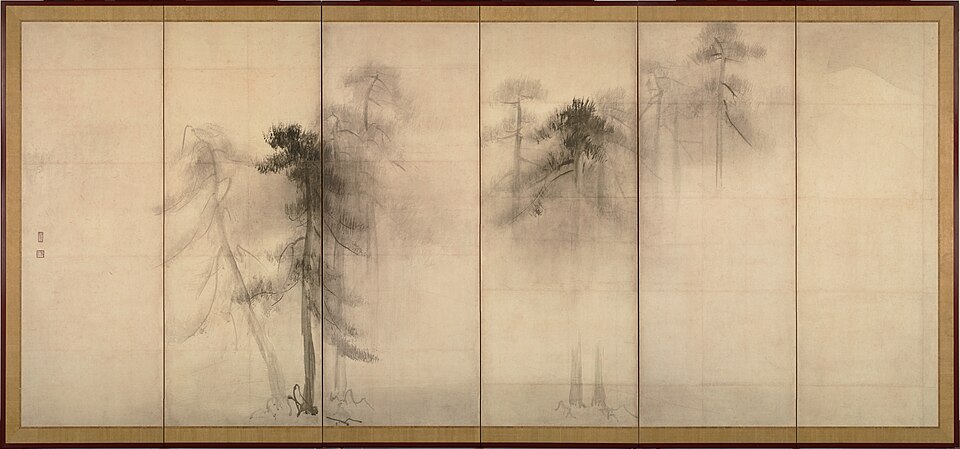
Hasegawa Tōhaku, "Pine Trees" screen (c. 1595)
Six panels of pine trees emerging from and dissolving into mist. The trees are barely there, ink wash on gold paper, more absence than presence. Tōhaku paints the moment before the trees disappear (or the moment after they've appeared). The mist isn't obscuring the trees; the mist IS the subject. The painting is about the boundary between visible and invisible, present and gone.
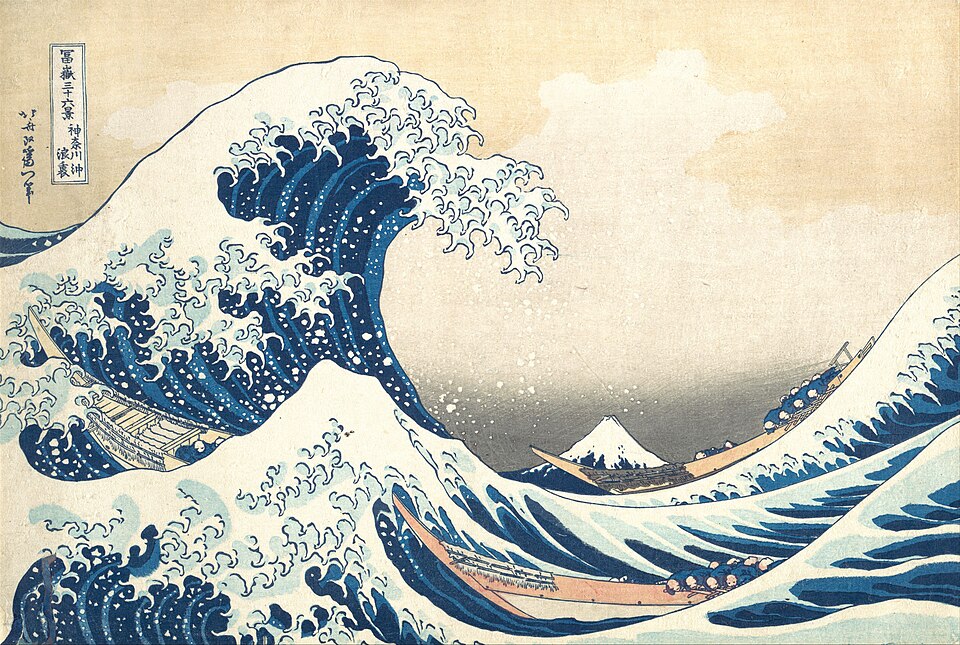
Hokusai — "The Great Wave" (c. 1831)
The most recognized Japanese image in the world. A wave curls over tiny boats, Mount Fuji calm and small in the background. The wave is caught at its absolute peak, the next instant it crashes. Hokusai froze the moment of maximum impermanence: the wave exists in this form for a fraction of a second. The entire power of the image comes from knowing it can't hold.
For Your Painting
Don't paint the birthday party. Paint the table after everyone has left, the half-eaten cake, the crumpled napkins, one balloon drifting. Don't paint the couple embracing. Paint them just after they've released, the arms still shaped by the other body, the warmth still present, the gap just opened. Mono no aware lives in the space between having and having-had.
Story 4
Wabi-Sabi, Beauty in Imperfection
The cracked bowl · Asymmetry as grace · Finding beauty where the West doesn't look
The Concept
Wabi-sabi (侘寂) — the aesthetic that finds beauty in imperfection, incompleteness, and impermanence. A cracked teabowl repaired with gold (kintsugi) is more beautiful than an unbroken one because the cracks tell a story. An asymmetric garden is more interesting than a symmetric one because perfection is dead and asymmetry is alive. Patina, weathering, wear, these aren't flaws. They're evidence of life having been lived.
Why It Matters for Painters
Classical Western training teaches you to idealize: perfect proportions, resolved edges, harmonious color. Wabi-sabi says: leave the crack. Leave the asymmetry. The imperfection is where the life is. For a painter working in the realist tradition, this is permission to paint the worn, the broken, the aged, the imperfect, not as subjects of pity but as subjects of reverence. The old woman's hands are more beautiful than the young woman's because they carry more story.
Kintsugi, repairing with gold, is a compositional metaphor. Where your painting "breaks" (the area that doesn't work, the transition that's rough, the passage that shows the struggle) — what if that's not a problem to fix but a place to fill with gold? The visible repair becomes the most beautiful part.
For Your Painting
Paint the thing the way it actually looks, not the way it's "supposed" to look. The peeling wall. The stained ceiling. The face with the scar. The body after surgery. The house that's lived in, not staged. Then find the gold in the cracks: the light that catches the scar, the color in the stain, the beauty in the wear. Western painting asks "how do I make this beautiful?" Wabi-sabi asks "how is this already beautiful?"
Story 5
The Islamic Garden, Paradise on Earth
The garden as sacred space · Geometry as devotion · Beauty as prayer
The Concept
In Islamic tradition, the garden (jannah) is paradise made visible on earth. The Quran describes paradise as gardens with flowing water, shade, and fruit. Islamic artists created the physical version: walled gardens divided into four quadrants by water channels (the chahar bagh), filled with fragrant plants, designed as spaces for contemplation. The garden is both a real place and a theological argument: if this much beauty can be made here, imagine what waits in the next world.
Islamic art also developed the most sophisticated geometric and calligraphic traditions in world art, partly because figurative representation was limited, artists poured their genius into pattern, geometry, and the written word as art form.
Why It Matters for Painters
Two enormous ideas for Western painters: First, the constructed environment as the subject not the figure, not the narrative, but the SPACE itself. A painting of a garden where the garden is the meaning, not the backdrop. The architecture of beauty as content. Second: geometry and pattern as emotional language. Islamic artists proved that pure geometric form, tessellations, arabesques, calligraphic flows — can produce profound emotional responses without depicting anything representational. The pattern IS the feeling.
For Your Painting
Paint a space, a garden, a room, a courtyard, where the beauty of the space IS the subject. No figure needed. The light falling through a window onto a tiled floor. The geometry of a well-designed room. The way water moves through a fountain. Islamic art teaches that beauty doesn't require a human figure to carry it, the space can carry it alone. Also consider: what role does pattern play in your painting? Could a geometric element (a tiled floor, a woven fabric, a window grid) carry emotional weight the way Islamic artists prove it can?
Story 6
The Ancestor, The Dead Who Are Not Gone
The dead as present · Memory as obligation · The living and the ancestors share the room
The Concept
Across many African traditions (Yoruba, Akan, Bantu, and others), the dead are not absent — they are present, watching, influencing, participating. Ancestors are consulted, honored, fed, and feared. The boundary between the living and the dead is permeable. A Yoruba masquerade doesn't "represent" the ancestor, the ancestor IS present, inhabiting the mask, moving through the living community. The dead are not in the past. They're in the room.
Why It Matters for Painters
Western painting usually treats the dead as absent, the empty chair, the photograph on the mantle, the ghost. African traditions offer a radically different compositional possibility: the dead person is IN the painting, as a present force, not a memory. Imagine a family dinner where the dead grandmother is seated at the table, not as a ghost but as a participant, acknowledged, served, part of the conversation. This isn't magical realism. It's a different ontology: the dead are here.
For paintings about grief, loss, and family, this framework opens compositions the Western tradition can't produce: the lost person as present, not absent. The painting doesn't mourn them, it includes them.
For Your Painting
Paint the family dinner with the dead grandmother present — not transparent, not ghostly, but SOLID, seated, real. The living family interacts with her or doesn't, but she's there. Or: a figure carrying their ancestor (metaphorically or literally), the weight of the dead on the shoulders of the living, not as burden but as company. The empty chair is a Western cliché. The occupied chair is an African insight.
Story 7
Dreamtime, The Eternal Present
All time is now · The land as story · Maps that are also myths
The Concept
In Aboriginal Australian tradition, the Dreamtime (Tjukurpa) is not "the past." It's an ongoing reality, the time when ancestral beings shaped the land, created the laws, and established the patterns of life. These events aren't historical; they're continuous. The rock formations, water holes, and paths in the landscape are ALIVE with the stories that created them. A painting of the land IS a painting of the story. Geography and mythology are the same thing.
Why It Matters for Painters
Aboriginal art collapses the distinction between map, story, and painting. A single image can be a literal depiction of a landscape, a record of an ancestral journey, and a sacred narrative, simultaneously. This is the most radical compositional idea in world art: the image operates on multiple levels at once, and each level is equally "true." For Western painters stuck in either representation OR abstraction, Aboriginal art proves that a painting can be both at the same time — a recognizable scene that is also a pattern, a map, a story, and a prayer.
For Your Painting
Paint a landscape that is also a biography. The streets you walked growing up, rendered as both literal geography and emotional map. The places where important things happened are brighter, larger, more detailed. The unimportant streets fade. The painting is a map of a life laid over a map of a place, and both are equally present. Dreamtime says: the land remembers everything. Your painting can too.
Story 8
Han, The Sorrow That Doesn't Resolve
Collective grief · Unresolved pain as identity · The wound that becomes strength
The Concept
Han (한) is a Korean concept with no English equivalent, a deep, collective sorrow born from generations of suffering (occupation, war, division, injustice) that doesn't resolve. It's not depression, it's a communal emotional state that encompasses grief, resentment, and endurance simultaneously. Han is the feeling of an entire people who have been wronged and haven't been made whole. Crucially, han is not only pain — it's also the creative energy that emerges from unresolved pain. Korean art, music, and food are often described as expressions of han transformed into beauty.
Why It Matters for Painters
Western art offers two responses to suffering: overcome it (triumph) or be destroyed by it (tragedy). Han offers a third: carry it, transform it, make something from it without pretending it's resolved. A painting made with han doesn't resolve. It doesn't offer hope or catharsis. It sits with the pain and finds beauty INSIDE it, not beyond it. For painters working on difficult subjects (the Seattle deep dive, the Conquest deep dive), han is the emotional register that might be most honest: not hope, not despair, but the specific beauty that lives inside sustained pain.
For Your Painting
Don't resolve the painting. Let the pain remain. A painting about homelessness doesn't need to offer hope. A painting about loss doesn't need a silver lining. Find the beauty that exists INSIDE the pain, the quality of light on a grieving face, the composition of a broken scene, the color of unresolved sorrow. Han says: the beauty and the pain are not separate. The wound IS the art.
· · ·
Using These Traditions
These concepts don't belong to you, and they don't need to. You don't have to adopt a tradition to learn from it. What you can do is let these ideas expand your compositional vocabulary:
When your painting feels stuck in Western either/or thinking (beautiful OR honest, narrative OR abstract, hopeful OR real), one of these traditions probably offers a BOTH. The Bodhisattva turns back. Mono no aware says the falling IS the beauty. Wabi-sabi fills the crack with gold. Han transforms the wound into the art. The ancestor is still in the room.
If a concept here moves you, go deeper. Read about the tradition. Look at the art. Talk to people who live inside these cultures. This chapter is a doorway, not a destination.